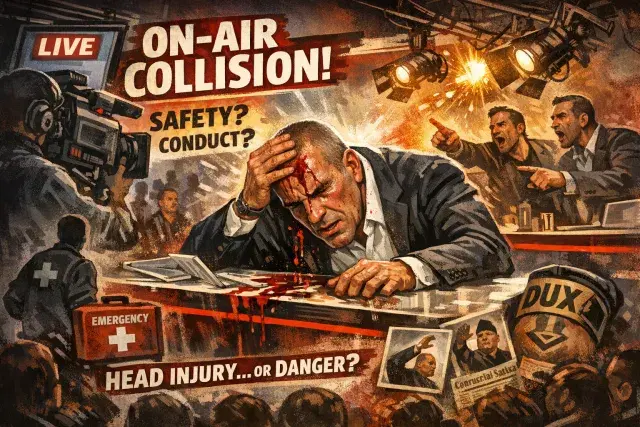

Paolo Di Canio was left visibly shaken after striking his head against a studio table during a heated television debate in Italy. The incident, which reportedly left him bloodied before he resumed his on-air role, drew immediate concern not only because of the apparent injury but because it unfolded in a live broadcast environment where impulse, performance and risk can collide in full public view.
A live studio injury is more than an on-air spectacle
Blows to the head can cause more than brief pain or visible bleeding. Even when a person remains conscious and continues speaking, a forceful impact may lead to confusion, dizziness, headache, delayed symptoms or, in some cases, concussion. Live television can obscure that reality: a presenter or guest may appear functional in the moment while still needing medical assessment, especially after repeated impacts such as those described in this case.
The setting matters too. Studio desks, lighting rigs and confined sets are built for broadcasting, not for sudden physical outbursts. When discussion formats reward confrontation and personality, the line between expressive performance and unsafe behaviour can narrow quickly. That is a workplace issue as much as a broadcasting one.
Why Di Canio remains a divisive figure
The reaction to the incident cannot be separated from Di Canio’s long public history. His media appeal in Italy has often rested on volatility and provocation, but that image has repeatedly overlapped with political controversy. He has faced sustained criticism over past fascist associations, including the “dux” tattoo linked to Benito Mussolini and an earlier public salute that caused outrage. Attempts to distance himself from those beliefs did not erase the record, and for many viewers his notoriety extends well beyond television punditry.
That history helps explain why incidents involving him rarely remain simple matters of temperament or personal embarrassment. They are interpreted through a wider pattern of conduct, symbolism and public responsibility. Broadcasters know that hiring polarising personalities can drive attention, but they also assume the reputational risk that comes with them.
The broader issue for television producers
Television debate has long rewarded conflict, interruption and theatricality. But there is a difference between forceful argument and behaviour that creates a risk of injury. Producers and networks are increasingly expected to think in terms of duty of care, not merely content value. That includes de-escalation in the studio, clearer intervention by hosts and a willingness to pause a broadcast if someone may have been hurt.
There is also a cultural question beneath the immediate incident. Viewers are accustomed to formats that blur analysis with confrontation, especially when familiar public figures are involved. Yet what draws an audience in the short term can also normalise behaviour that would be unacceptable in most workplaces. A head injury treated as a moment of dramatic television may keep a segment moving, but it sends a confused message about acceptable conduct and basic safety.
What should have mattered most after the impact
The first priority after any significant blow to the head should be the person’s condition, not the continuity of the programme. Visible bleeding, disorientation or repeated impact all point to the need for prompt assessment. Even if the injury proves minor, stopping to check is the responsible response.
That is the clearest takeaway from a bizarre broadcast moment that might otherwise be dismissed as just another outburst from a well-known provocateur. The real issue is not only what Di Canio did, but what live television chooses to treat as entertainment, what it overlooks in the name of momentum and what safeguards are in place when performance turns into harm.