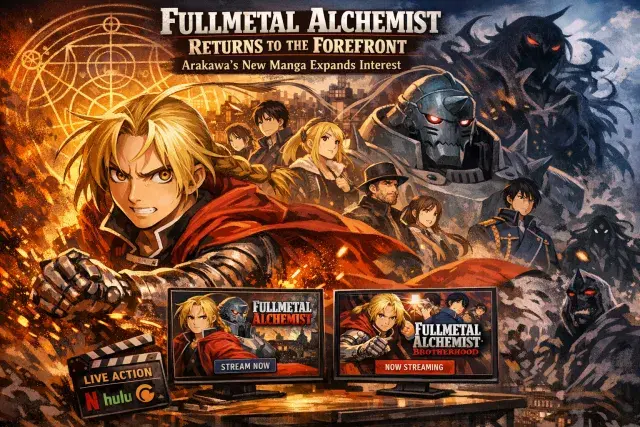

Hiromu Arakawa’s Daemons of the Shadow Realm has done more than launch a new conversation around her work. It has also sent many viewers back to Fullmetal Alchemist, the franchise that remains her defining global cultural export, and raised a practical question for newer audiences: which version to watch, and where to find it.
In 2026, that question has a relatively simple answer. Fullmetal Alchemist and Fullmetal Alchemist: Brotherhood are available across major streaming platforms, with Brotherhood enjoying the broadest reach, while the live-action film remains tied mainly to Netflix.
Why Fullmetal Alchemist still matters
Fullmetal Alchemist has endured because it offers more than action or fantasy. Arakawa built the story around grief, militarism, scientific ambition, bodily loss, and the moral cost of trying to reverse death. The central rule of Equivalent Exchange gives the series its philosophical frame, but the deeper appeal lies in how often that rule fails to provide moral clarity. Edward and Alphonse Elric are not simply trying to fix a mistake; they are confronting a world where institutions exploit knowledge, where power hides behind bureaucracy, and where human life is often treated as material.
That mix helps explain why the franchise continues to attract returning viewers. For longtime fans, revisiting the series can feel like returning to a formative work. For new audiences arriving through Daemons of the Shadow Realm, it offers a clear entry point into Arakawa’s recurring interests: family bonds, political violence, and systems that demand sacrifice from the vulnerable.
Where the series is streaming in 2026
According to the provided availability details, both the 2003 Fullmetal Alchemist and the 2009 Fullmetal Alchemist: Brotherhood can be streamed on Crunchyroll. Brotherhood is also available on Hulu and Netflix, giving it a wider footprint for casual viewers who may already subscribe to a general entertainment service rather than an anime-focused one.
- Crunchyroll: Fullmetal Alchemist and Fullmetal Alchemist: Brotherhood
- Hulu: Fullmetal Alchemist: Brotherhood
- Netflix: Fullmetal Alchemist: Brotherhood and the 2017 live-action film
The live-action adaptation occupies a smaller place in the franchise’s legacy. Its existence still speaks to the breadth of Fullmetal Alchemist’s reach, but for most viewers, the anime remains the essential format because it carries the emotional architecture and political scale of the story far more effectively.
Which version to watch first
The most important distinction is not quality in a simple sense, but intent. Fullmetal Alchemist from 2003 began before the manga had finished, so it eventually diverges into its own interpretation. Brotherhood was produced later and follows Arakawa’s completed manga much more closely across 64 episodes.
The earlier series often gives more room to mood, tragedy, and intimate character development in its opening stretch. Brotherhood moves faster at first, partly because it assumes some familiarity and partly because it is trying to cover the full arc of the source material. The result is that the 2003 version can feel more meditative, while Brotherhood is the definitive choice for viewers who want the complete canonical story as Arakawa wrote it.
That split is one reason the franchise remains unusually durable. These are not redundant adaptations. They are two distinct responses to the same premise, and each reveals something different about how anime production can reshape a narrative once it leaves the page.
Why streaming access keeps older anime alive
The renewed attention around Fullmetal Alchemist also reflects a broader shift in viewing culture. Older anime no longer survive only through physical media, fan recommendation, or fragmented clips circulating online. Streaming platforms have turned major catalog titles into perpetually available cultural touchstones, ready to be rediscovered whenever a new release, anniversary, or creator spotlight sends audiences back.
That matters for a work like Fullmetal Alchemist because its themes have aged well. Questions about state violence, unethical research, and the promise that technology or technique can solve grief remain potent. Arakawa’s newer work may be the trigger for renewed curiosity, but the reason viewers stay with the Elric brothers is simpler: the story still feels urgent, and it still rewards attention.